
Tip pool calculator · 100% free · no signup
Tip Pool & Tip Out Calculator
Split tips fairly across servers, bartenders, bussers, and runners. Choose by hours worked, by role (some jobs count more), or even split. You get what each person takes home, with the math shown.
Why this matters
A bad tip pool kills more teams than slow shifts.
Tipped employees notice every dollar. A pool that runs cleanly is invisible. A pool that drifts, math errors, missing hours, perceived favoritism, becomes the entire conversation in the back hallway by week two.
The fix isn't a fancier formula. It's consistency, transparency, and arithmetic that anyone can verify. Post the totals at end of shift. Show the formula. Let any employee recount on the spot.
Hours-weighted is the simplest and best defense against accusations of favoritism. Points-weighted is fairer when roles have meaningfully different responsibility. Both work, what doesn't work is changing the method without telling the team.
And remember the federal rules: managers never in the pool, back-of-house only if no tip credit is taken, credit card fee deductions only at actual rate. The labor lawsuits in this category are routinely six-figure. Get it right.
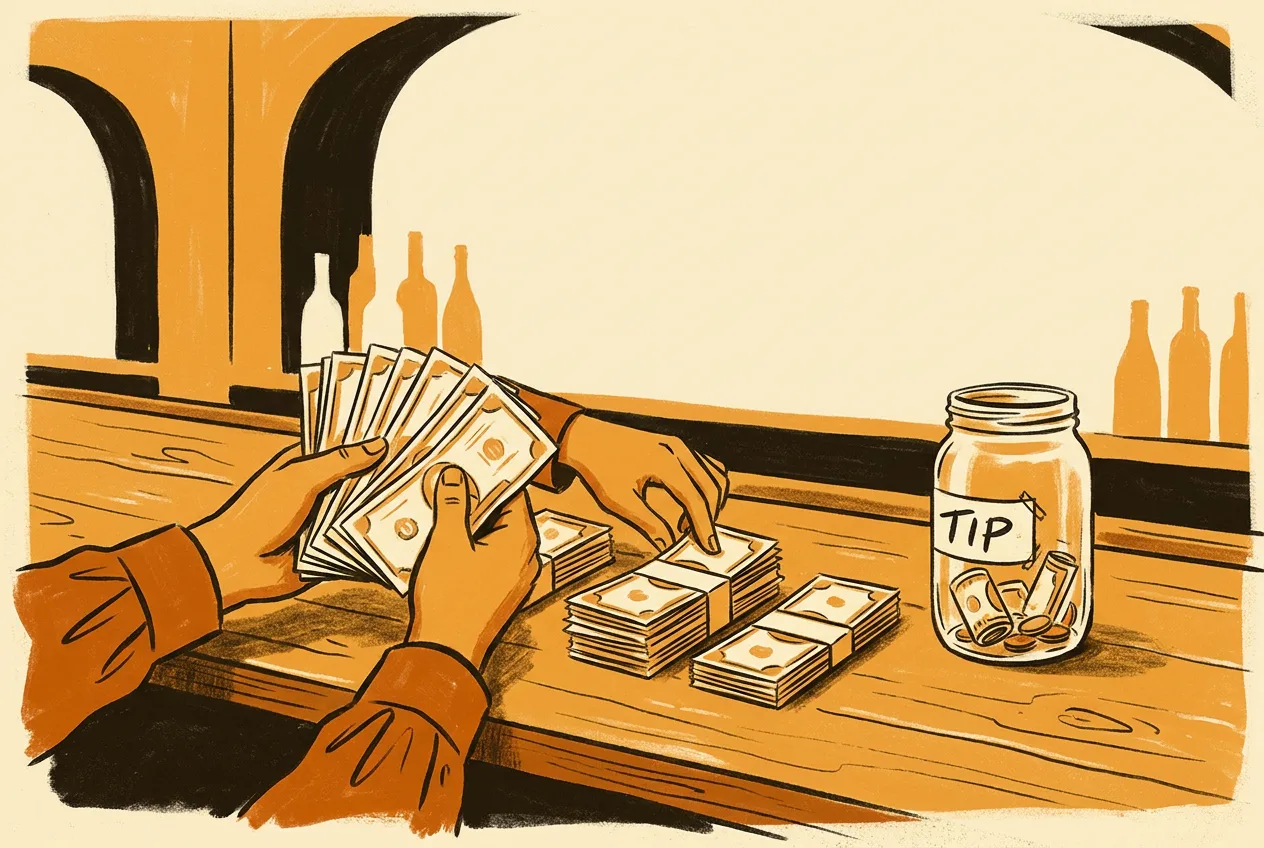
From behind the bar
The tip pool is where the team breaksor doesn't.
I bartended at Cosmos for years before becoming GM. In that time I watched tip pool fights end friendships, end shifts early, end careers. The math is the easy part. The conversations around the math are the entire game.
The first thing I learned: hours-weighted is the only system that survives a busy Saturday with three new hires and one senior bartender. Equal split feels fair on paper but punishes the senior who actually carries the rush. Points-weighted feels fair until somebody asks why the bartender's points are double the busser's, and then you're defending an org chart on a Friday at 2am.
The second thing I learned: post the math. Print it. Tape it to the wall. Show every line, pool total, hours, share. Anybody on the team can recount it in thirty seconds. Transparency kills the conspiracy theories before they start. The minute somebody thinks the pool is rigged in someone else's favor, the team is broken until the next reset, and the next reset costs you a night.
The bartender who works hardest doesn't notice the tip pool. The bartender who works the least notices it the most. Both are signals.
The third thing, and this one matters legally, is that managers and supervisors cannot legally take from the pool, ever, regardless of how much they helped on the floor. I had to give that conversation to owners more than once. The 2018 FLSA amendment is unambiguous. The 2024 Fifth Circuit ruling on the 80/20/30 rule didn't change it. Managers receiving tips from a pool is a direct DOL violation and a six-figure lawsuit waiting to happen.
That's why this calculator has the FLSA banner, the tip-credit toggle, and the BOH violation warning. The math is simple. The legal compliance is what kills operators who don't pay attention.
FAQ
Common questions
01 How does a restaurant tip pool work?
A tip pool combines tips from all tipped employees and redistributes by a defined formula, usually weighted by hours worked, by points (role-based weight), or by a hybrid. Pools encourage teamwork and protect tipped employees from slow shifts. Federal law (FLSA) governs which roles can be in the pool, back-of-house can only be included if no tip credit is taken.
02 What is hours-weighted vs points-weighted distribution?
Hours-weighted: each employee's share = (their hours ÷ total hours) × total pool. Simple and fair. Points-weighted: each role gets a point value (server 10, bartender 8, busser 5, runner 4); each employee's share = (their points × their hours) ÷ (sum of all points × hours) × total pool. Points reflect role-specific responsibility and effort.
03 What is tip out vs tip pool?
Tip out: a server keeps the majority of their tips and "tips out" support staff by paying a percentage of sales (or tips) to bartender, busser, runner, etc. Common percentages: bartender 5–8% of liquor sales, busser 2–4% of food sales, runner 1–2%. Tip pool: ALL tips combined and redistributed. Different states and operators favor different models.
04 Is a tip pool legal?
Yes, federally, but with strict rules. Mandatory pools are legal for tipped employees who customarily receive tips. Back-of-house can only be in the pool if NO tip credit is taken (you pay full minimum wage to all tipped employees). Managers and supervisors can never be in the pool. State laws vary, some are stricter. Consult a labor attorney before implementing.
05 Can managers be in the tip pool?
No. Federal law prohibits managers and supervisors from receiving tips from a pool, regardless of whether tip credit is taken. "Manager" is defined as someone with authority to hire, fire, supervise, or direct other employees. A working bartender who occasionally directs traffic isn't a manager; a salaried floor manager is.
06 How do I handle credit card processing fees on tips?
Federal law allows employers to deduct the credit card processing fee from the tip portion before distribution, but the percentage must match the actual fee, not be marked up. Many operators don't deduct it because the optics are bad and the savings are small. Document your policy clearly.
07 How often should tips be distributed?
Most operators distribute weekly with the regular paycheck (pretax) or daily in cash at end of shift. Daily is more popular with employees but harder to administrate. Weekly through payroll is cleaner for taxes but creates float. Both are legal. Pick a convention and document it in the employee handbook.
08 What if tips need to go up to minimum wage?
If the tip credit jurisdiction allows you to pay below minimum wage (federal $2.13/hr for tipped employees), you must "true up" to minimum wage if pooled tips don't bring an employee to minimum. The employer is responsible for the gap. Track this carefully, it's the most common wage-theft lawsuit category in restaurants.
09 Does this calculator save my data?
No. Nothing is stored, transmitted, or tracked. The calculation runs entirely in your browser and disappears the moment you close the tab. No signup, no email, no account.
Cited sources