
Liquor pour cost calculator · 100% free · no signup
Liquor Pour Cost Calculator
Pour cost is the percent of a drink's sale price that goes to the booze itself. Bar margin slips faster than food, a heavy hand on the bottle, drink after drink, quietly eats your profit. This tool figures pour cost by category, liquor, beer, wine, or all of them combined, and tells you whether each one is in a healthy range.
Why this matters
Liquor cost is velocity-driven.
Food cost moves on inventory cycles, weeks, sometimes months. Liquor cost moves on pours, in real time. Every drink poured is a small inventory transaction. A 0.2-oz over-pour times 800 cocktails a week is 160 ounces of liquor walking out the door uncharged.
The math is unforgiving. A bottle of well vodka costs ~$15 wholesale. At 1.5oz spec, that's ~$0.59 per pour. At 1.7oz actual, it's $0.67. Eight cents, eight hundred times = $64/week, $3,300/year per bartender. Most bars have three.
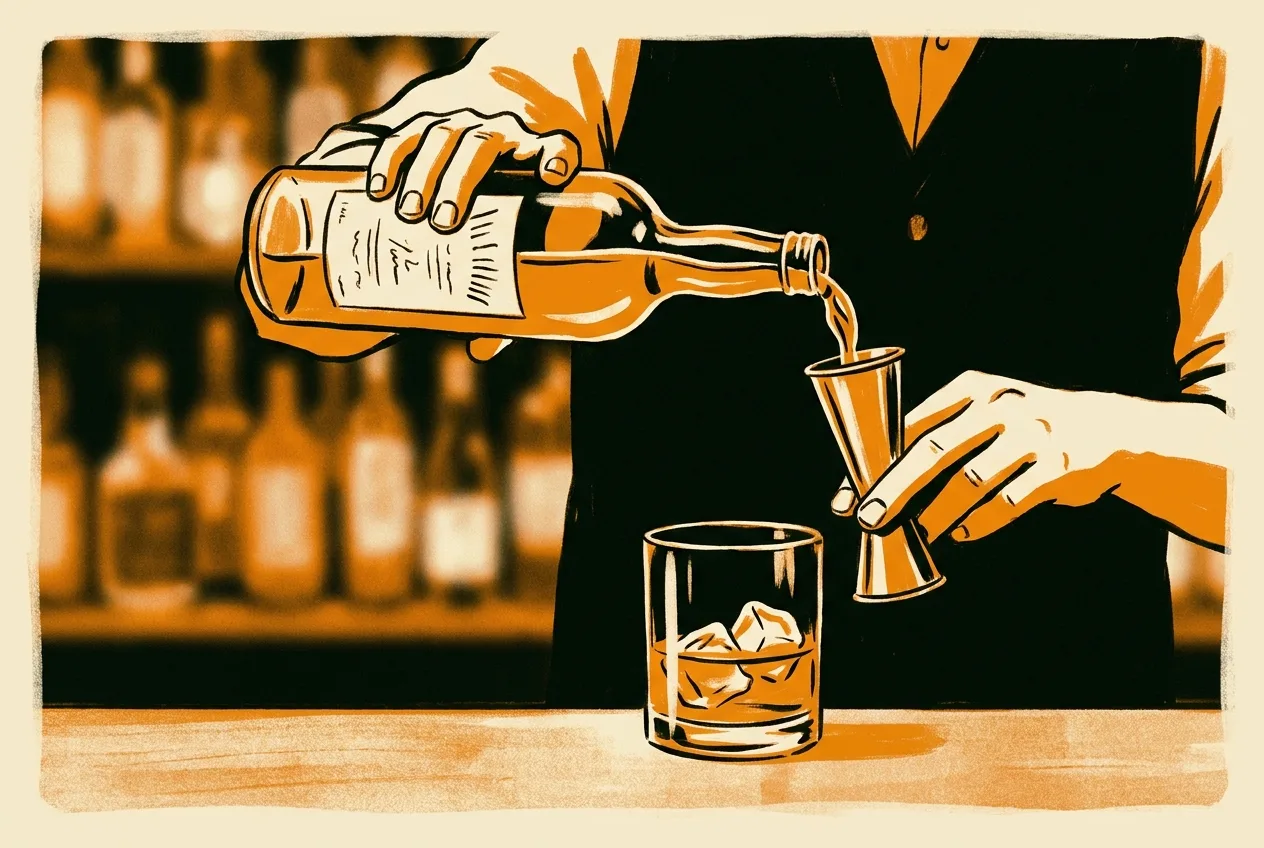
The operators who control liquor cost don't run smarter calculators. They use measured pour spouts, jiggers on every well, and weekly variance checks on the top 10 bottles. Those three habits beat any software stack.
Track each category separately. A blended pour cost number hides which category is leaking. Wine and beer behave differently from spirits, different supplier dynamics, different markup conventions, different theft profiles.
From behind the bar
Five years on the bar taught me where the money actually leaks.
I started at Cosmos as a bartender and worked my way up to GM. I ran the bar and the nightclub for five years solid. In that time I've watched every kind of pour cost leak you can imagine, and most of them aren't theft, they're habits nobody flagged.
The biggest one was free pours on the well. New bartenders don't trust jiggers. They eyeball it because that's what they saw on YouTube. Two ounces becomes two-and-a-half before anyone notices. Multiply by three hundred drinks on a Saturday night and you've quietly given away more product than a comp tab would have flagged. Nobody's stealing. Nobody's malicious. It just bleeds.
The second one was buyback culture. Regulars walked in, the bartender bought their first round, the second round was on the house "for being cool." On a slow Tuesday it built loyalty. On a busy Saturday it cost real money, and nobody was tracking it as a cost line, just as goodwill.
The bartender who pours by feel, the bartender who buys back too generously, the bartender skimming a bottle a week, to the pour cost percentage, they look identical. The number tells you something is wrong. It doesn't tell you which kind of wrong.
The third one was the one I had to learn the hard way: when the owner's not engaged in the bar program, the bar program drifts. I was running variance reports myself for three of those five years because nobody else was. The math is simple. The discipline of doing the math weekly, counting the bottles, comparing to POS, finding the gap, is the entire game.
That's what this calculator is for. Per-drink mode tells you what each pour should cost. Aggregate mode tells you whether your program is in the healthy band. The gap between those two numbers is where the leaks live. Find them every week, fix them in the same week, and you stay open. Skip a quarter and you're suddenly down four points and don't know why.
Benchmarks by beverage category
Each beverage category has its own healthy range. Spirits are tightest (high markup, small pours). Wine is loosest (premium product, smaller markup convention). Track separately.
Real scenarios
Three programs, three different leaks
High pour cost is a symptom. The cause is usually one of three things, or a combination.
The 32% liquor program
Cocktail bar, liquor pour cost stuck at 32% for 6 months. Owner blamed inflation.
Free-pouring on the well, bartenders not using measured spouts. Audit found average pour 1.7oz vs spec 1.5oz. That 13% over-pour at scale = 4pp pour cost.
Installed measured pour spouts on all wells, retrained bartenders, set weekly variance check on top 10 bottles.
Down to 21% in 4 weeks. $3,800/month margin recovered. Guest complaints zero, they couldn't tell.
The 18% beer program (suspicious)
Sports bar, beer at 18%, looked great. Owner noticed kegs running out faster than POS sales suggested.
Theft. Bartender comping pints to friends, ringing them as voids. Variance vs theoretical was 11pp (real pour cost was 29%).
POS lockdown on voids, inventory audit per shift, terminated bartender, replaced 2 measured-pour kegs.
Real pour cost 24%. Caught $1,200/month theft. Sets variance baseline for new hires.
The 38% wine program
Italian concept, wine pour cost at 38%, well above 32% target. Wine list was strong, sommelier was certified.
By-the-glass pricing not updated in 18 months. Wholesale costs up 22% across two distributors. Menu prices unchanged. By-the-bottle was fine, by-the-glass was the leak.
Repriced 8 BTG selections by $2–4. Added 3 new accessible BTG options at lower cost. Capped pours at 5oz with measured glass.
Wine pour cost 31% within 60 days. Guest complaints minimal. Sommelier kept the job.
FAQ
Common questions
01 What is a good liquor pour cost percentage?
Liquor (spirits) typically targets 18–24% pour cost. Beer runs 25–30%. Wine runs 28–35%. A combined beverage program usually lands at 20–25%. Cocktail-heavy bars can hit 16–20% on liquor through tight portion control. Anything sustained above 30% on liquor signals over-pouring, theft, comping, or under-pricing.
02 How do you calculate pour cost?
Pour Cost % = (Beverage Cost ÷ Beverage Revenue) × 100. Beverage cost is what you paid suppliers for the period. Beverage revenue is what you sold for the same period. The discipline is matching periods cleanly, don't mix this week's revenue with last month's purchases.
03 Should I track liquor, beer, and wine separately?
Yes. Combined pour cost hides which category is leaking margin. Most operators track three separate %s plus a blended number. Wine programs especially benefit because by-the-glass and bottle pricing have different cost structures.
04 Why is my pour cost too high?
Ranked by frequency: (1) free pours, bartenders not using jiggers or measured spouts, (2) comping comp comping, too many "manager comps" or shift drinks not tracked, (3) outdated cocktail recipes, costs went up, prices didn't, (4) theft, common in high-volume bars without inventory discipline, (5) breakage and spillage uncounted, (6) inventory miscount on month-end.
05 How do I lower pour cost without losing customers?
Switch to measured pour spouts or jiggers (immediate 2–4pp drop typical). Reprice cocktails to match current liquor cost (most menus haven't kept up with inflation). Eliminate comp shift drinks or cap them. Audit your most-poured bottles, that's usually where the leak is.
06 How often should I run pour cost?
Weekly. Liquor cost moves faster than food cost because volume per item is lower and over-pour is easy to hide. Best operators run a daily inventory variance on the top 5 spirits.
07 What is a "perfect pour" vs "actual pour" report?
Perfect pour is your theoretical cost based on recipes and POS-tracked drinks sold. Actual pour is real inventory consumed. The variance flags over-pouring, comping, and theft. Variance >5% is investigation territory. Variance >10% means immediate audit.
08 Should comp drinks be included?
In your cost number, yes (you paid for the liquor). In your revenue, no (you didn't collect on it). That asymmetry is what makes excessive comping crush pour cost. A 4-ounce $9 cocktail that gets comped costs you the liquor PLUS the lost margin. Track comps separately as a percentage of total pours.
09 Does this calculator save my data?
No. Nothing is stored, transmitted, or tracked. The calculation runs entirely in your browser and disappears the moment you close the tab. No signup, no email, no account.
Cited sources